Pocket Alternative · Updated April 2026
The 5 Best Pocket Alternatives in 2026 (Tested & Compared)
Mozilla shut down Pocket on July 8, 2025 after 18 years, leaving millions of users to find somewhere new. Below are the 5 best replacements we've tested, compared on price, platforms, and what they're actually good at. Includes the AI-first approach LaterCue takes to the “saved but never read” problem.
Quick verdict — skip to the one that fits
| If you want… | Pick | Starting at |
|---|---|---|
| To actually do something with saved links | LaterCue | $7.99/mo (7-day free trial) |
| The closest match to Pocket's reading experience | Instapaper | Free / $6/mo Premium |
| The best free tier with organization | Raindrop.io | Free / $3.15/mo Pro (annual) |
| A power-user reading hub (articles + RSS + PDFs + highlights) | Readwise Reader | $9.99/mo annual (30-day trial) |
| Open source and self-hosted | Omnivore (community fork) | Free |
| Native Apple app, no required subscriptions | GoodLinks | $9.99 one-time |
Why LaterCue instead of another bookmark manager?
Bookmark managers solve the wrong problem. The issue was never where you save links — it's that you save them and never act on them. Pocket had 30 million users saving articles “for later.” How many actually got read?
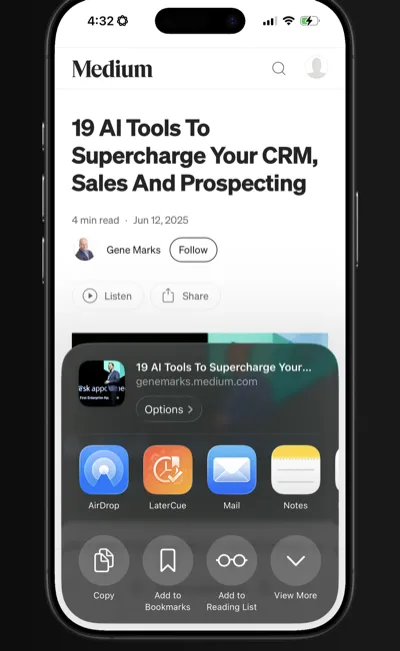
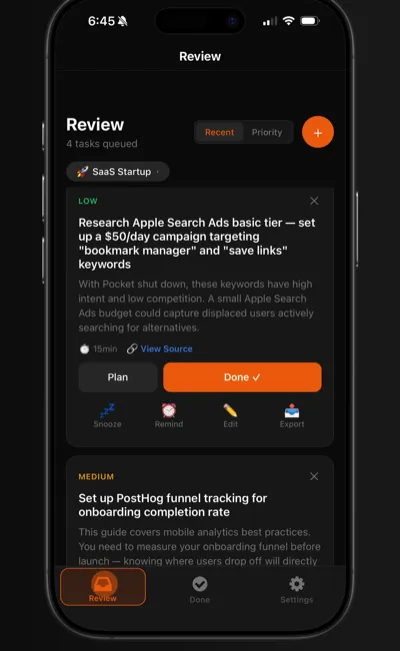
LaterCue takes a different approach. When you share a link, our AI reads the full content — articles, threads, screenshots — and extracts one specific, actionable task based on your business goals. Instead of a reading list that grows forever, you get a to-do list that actually shrinks.
For developers and founders, LaterCue also includes a Model Context Protocol (MCP) server. This gives AI coding agents like Claude Code, Cursor, and Windsurf direct access to your task queue — so you can ask your agent “What should I work on next?” and get an answer from your real priorities.
What happened to Pocket?
Mozilla announced Pocket's shutdown on May 22, 2025, and the service officially went dark on July 8, 2025, after 18 years. Millions of registered users had to find somewhere new. The export window closed on October 8, 2025 — after that, Pocket data was permanently deleted.
Mozilla framed the decision as a shift of resources toward Firefox. The underlying reality: Pocket was a read-later tool built for an internet that looked different. With 30M saved articles and a small percentage ever revisited, the “queue gets bigger forever” problem outlasted the product.
If you missed the export window, your Pocket library is gone. You can't recover it. The good news: the apps below all let you start fresh — and some of them rethink the read-later model entirely, which is where LaterCue fits.
Quick Answer
Most Pocket alternatives do one of two things: they let you read later, or they help you act later. Most people think they want the first. Most people actually need the second.
If you want a cleaner version of Pocket: use Instapaper or Raindrop.io.
If you want to actually do something with what you save: use LaterCue.
Pocket Alternatives — Feature Comparison
Updated April 2026
| Feature | LaterCue | Raindrop.io | Instapaper | Omnivore | Readwise Reader | GoodLinks |
|---|---|---|---|---|---|---|
| AI task extraction | ✓ | — | — | — | — | — |
| X (Twitter) bookmark sync | ✓ | — | — | — | — | — |
| Screenshot OCR | ✓ | — | — | — | — | — |
| Business context prioritization | ✓ | — | — | — | — | — |
| MCP server (AI agent access) | ✓ | — | — | — | — | — |
| Notion export | ✓ | ✓ | — | — | — | — |
| iOS Share Sheet | ✓ | ✓ | ✓ | ✓ | ✓ | ✓ |
| Save articles to read later | ✓ | ✓ | ✓ | ✓ | ✓ | ✓ |
| Tags and folders | — | ✓ | ✓ | ✓ | ✓ | ✓ |
| Free tier | ✓ | ✓ | ✓ | ✓ | 30-day trial, then $9.99/mo | $9.99 one-time |
| Open source | — | — | — | ✓ | — | — |
1. Raindrop.io — Best Free Pocket Replacement
Pricing: Free / $3.15/mo Pro (annual) · Platforms: Web, iOS, Android, macOS, Windows, browser extensions
Raindrop.io is the most-recommended free Pocket alternative in 2026, and with good reason. It has unlimited bookmarks on the free plan, nested collections, tags, full-text search, a built-in reader mode, and cross-platform sync. Its browser extension is polished, its mobile apps are fast, and its web interface is genuinely pleasant to use — a rare combination.
Best for: People who want Pocket's save-organize-retrieve workflow with more structure. Researchers, designers building inspiration boards, and anyone who actually revisits their saved content will get the most out of Raindrop. The Pro plan ($3.15/mo billed annually, or $3.54/mo monthly) adds permanent copies, highlighting, and nested collection AI search.
Key weakness: Raindrop solves organization, not action. A beautifully tagged bookmark library has the same core problem as Pocket did: the content still sits there until you open it. If your saved links pile up faster than you can read them, Raindrop just gives you prettier folders to ignore.
LaterCue vs Raindrop.io: Raindrop organizes your reading list. LaterCue replaces it with a to-do list. AI reads each saved link and extracts the specific action — “Reach out to this VC by Friday,” “Try this SDK in your auth flow,” “Consider this pricing model for your next tier.” Raindrop is excellent reference storage. LaterCue is forward motion.
2. Instapaper — Closest to the Old Pocket Experience
Pricing: Free basic / $6/mo or $60/yr Premium · Platforms: iOS, Android, Web, Kindle
Instapaper is the OG read-later app — older than Pocket, and now independent again after being bought back from Pinterest in 2018. Its core design hasn't drifted: strip out ads and formatting, present the article cleanly, save offline, and sync across devices. If you miss Pocket's reading experience specifically, Instapaper is the drop-in replacement.
Best for: Long-form readers who want distraction-free reading and don't care about fancy AI features. Instapaper's Kindle export (free tier) is still one of the best ways to ship saved articles to an e-reader for actual reading. Premium ($6/mo or $60/yr) adds unlimited notes, highlights, and full-text search.
Key weakness: Instapaper is stuck in the read-later paradigm. It optimizes the reading experience but doesn't change the core dynamic — content still waits for you to show up. If you're saving 10 articles a week and reading 2, Instapaper doesn't solve that. It just makes the 2 you do read more pleasant.
LaterCue vs Instapaper: Instapaper is for people who love to read and save long articles faster than they consume them. LaterCue is for people who don't have time to read 50 saved articles at all — AI reads them instead and surfaces the one action worth taking. Different solutions to different flavors of the same problem.
3. Readwise Reader — Most Feature-Rich (for Power Readers)
Pricing: $9.99/mo annual ($119.88/yr) or $12.99/mo monthly (30-day free trial; bundled with Readwise) · Platforms: iOS, Android, Web
Readwise Reader is the most feature-rich read-later app available in 2026. It consolidates articles, RSS feeds, newsletters, PDFs, EPUBs, Twitter/X threads, and YouTube transcripts into a single reading hub. It highlights across everything, and the Readwise daily review resurfaces your highlights on a spaced-repetition schedule. For people who want to actually retain what they read, Readwise has no real competition.
Best for: Power readers, researchers, students, and knowledge workers who read dozens of articles per week and want to build a durable personal knowledge base. Integrations with Notion, Obsidian, and Roam make it easy to feed highlights into a second brain workflow.
Key weakness: Readwise Reader is complex and expensive. At $9.99/mo annual (or $12.99 monthly), with no free tier (30-day trial only) and bundled with the full Readwise highlight stack you may not need, it's overkill for casual users. Onboarding takes real time, and the feature surface can be overwhelming. If you're reading 3 articles a week, you're paying for horsepower you won't use.
LaterCue vs Readwise Reader: Readwise is about retention — reading more, highlighting, and reviewing. LaterCue is about action — reading less, extracting the takeaway, moving on. For founders and builders with 50 unread tabs, LaterCue turns the backlog into a prioritized task list. Readwise turns it into a better reading experience you still have to find time for.
4. Omnivore — Open-Source and Self-Hostable
Pricing: Free (open-source, community-maintained) · Platforms: Web, iOS, Android, self-hosted
Omnivore was a fully free, open-source read-later app with newsletter support, highlights, and a loved-by-power-users feature set. In October 2024, the team was acqui-hired by AI voice company ElevenLabs, and the hosted service shut down on November 30, 2024. User data on the hosted service was deleted. The codebase remains open on GitHub (~16K stars), and a community fork at omnivore.work offers self-hosted deployments for those willing to run their own instance.
Best for: Privacy-conscious users, developers who want control over their data, and anyone avoiding subscriptions on principle. Self-hosting gives you full ownership — no rug-pulls, no terms-of-service changes.
Key weakness: The original team no longer maintains the code; they moved to ElevenLabs to work on ElevenReader. Self-hosting requires server comfort and willingness to maintain the stack yourself. For most people, “free and open source” really means “free if you value your own time at zero.”
LaterCue vs Omnivore: Omnivore is feature-rich storage — still in the read-later paradigm, just without a company behind it. LaterCue is fundamentally different in approach: AI reads the content so you don't have to. If you're drawn to Omnivore for open-source purity, LaterCue isn't your match. If you're drawn to it because Pocket disappointed you by storing forever-unread content, LaterCue might be.
5. GoodLinks — Best for Apple Users Who Hate Subscriptions
Pricing: $9.99 one-time on the App Store · Platforms: iOS, iPadOS, macOS
GoodLinks is a premium native iOS/iPadOS/macOS read-later app with a one-time price, no subscriptions, and beautiful typography. It has tags, iCloud sync, offline reading, keyboard shortcuts on Mac, and widgets on iOS. For $9.99 once, it's one of the best values in productivity software — if you're inside the Apple ecosystem. An optional Premium subscription unlocks features released more than a year after your purchase.
Best for: Apple-only users who want a native, polished app without recurring charges. Anyone who resents subscription creep will appreciate GoodLinks' “pay once, use forever” model. It feels like software from the pre-SaaS era, in a good way.
Key weakness: Apple-only. No web interface, no Android, no Windows. Limited newsletter/RSS support compared to Readwise. Development cadence is slower (as you'd expect from a one-time-purchase app). If you live across platforms, GoodLinks won't follow you everywhere.
LaterCue vs GoodLinks: Both are native iOS apps. Both respect your time. The difference: GoodLinks stores links beautifully; LaterCue acts on them. GoodLinks is what Pocket should have been — a polished native reading experience without the acquisition drama. LaterCue is the AI-era evolution that skips the reading step for most of what you save.
How to migrate from Pocket (if you still can)
If you exported before October 2025: you have a CSV file with your saved URLs, titles, tags, and timestamps. Both Instapaper and Raindrop.io accept direct Pocket CSV imports from their settings pages — one upload and your entire library moves over.
If you missed the export window: your Pocket data is gone. Mozilla deleted saved content after October 2025. There is no recovery path. The only way forward is to start fresh.
If you're moving to LaterCue: we intentionally don't support bulk CSV import. Dumping 500 old bookmarks into LaterCue would recreate the exact backlog problem you had with Pocket — and that defeats the point. Instead, re-save links via the iOS Share Sheet as you encounter them again. AI extracts a fresh, prioritized task for each one, based on your current business goals. Most people find the forced restart surprisingly clarifying.
If you're splitting tools: many former Pocket users now use Raindrop or Instapaper for long-form reading material and LaterCue for actionable content (threads, research links, competitor intel, product tips). Different jobs, different tools. Instapaper for reading. LaterCue for doing.
Pricing Summary — What Each One Costs
Annual pricing as of April 2026. Verify on the vendor's site before purchasing.
| App | Free tier | Paid | Platforms | Best for |
|---|---|---|---|---|
| LaterCue | 7-day trial (full Pro) | $7.99/mo | iOS | Founders drowning in saved links |
| Raindrop.io | Unlimited bookmarks | $3.15/mo (annual) | Web, iOS, Android, Mac, Windows | Organizing a reference library |
| Instapaper | Basic reader | $6/mo or $60/yr | iOS, Android, Web, Kindle | Clean, focused reading |
| Omnivore | Self-host only | Free (OSS) | Self-hosted via community fork | Privacy and full data ownership |
| Readwise Reader | 30-day trial | $9.99/mo (annual, bundled) | iOS, Android, Web | Power readers and researchers |
| GoodLinks | — | $9.99 one-time | iOS, iPadOS, macOS | Apple users who hate subscriptions |
The Real Problem Pocket Never Solved
The average Pocket user saved dozens of links per month and opened a fraction of them. That wasn't a Pocket problem: it's the default outcome for any app that treats saving and acting as separate steps.
The save-later model made sense when the internet was slower and you needed to set things aside. Now everything is accessible instantly, and the bottleneck isn't access: it's attention and follow-through.
Every app on this page except LaterCue assumes you'll come back to your queue and decide what to do. LaterCue removes that step by deciding at save time — AI extracts the task, prioritizes it against your other work, and the original link becomes reference material instead of a todo you have to read first.
Frequently Asked Questions
What is the best Pocket alternative in 2026?
It depends on how you used Pocket. For the closest feature match: Instapaper. For the best free tier and organization: Raindrop.io. For power readers who highlight everything: Readwise Reader. For people who save links they never actually read: LaterCue, which uses AI to turn saved links into specific tasks instead of storing them for later.
What is the best free Pocket alternative?
Raindrop.io has the most generous free tier — unlimited bookmarks, nested collections, full-text search, and a built-in reader. Instapaper has a solid free tier for basic reading. LaterCue offers a 7-day free trial with full Pro access.
Is Pocket completely gone?
Yes. Mozilla shut down Pocket on July 8, 2025. The app is no longer available, user data has been deleted, and there is no recovery path. The only window to export your saved content closed on October 8, 2025.
Which Pocket alternative supports Pocket CSV import?
Instapaper and Raindrop.io both support direct import of Pocket CSV exports from their settings pages. For LaterCue, we recommend manually re-saving your most important links via the iOS Share Sheet — bulk importing just recreates the backlog problem you had with Pocket.
Is there a Pocket alternative for Android?
LaterCue is currently iOS only. For Android users, Instapaper, Raindrop.io, and Readwise Reader all offer full-featured Android apps.
What's the closest thing to Pocket?
Instapaper is the closest feature-for-feature Pocket replacement: the same clean reading view, offline support, simple save interface, and Kindle export. If you miss Pocket's reading experience specifically, Instapaper is the drop-in answer.
How much do Pocket alternatives cost in 2026?
Free options: Raindrop.io (strong free tier), Instapaper (basic free tier). Omnivore is open-source but the hosted service shut down in November 2024 — only self-hosted instances remain. Paid: Readwise Reader ($9.99/mo billed annually, bundled with the full Readwise stack), LaterCue Pro ($7.99/mo after 7-day trial), GoodLinks ($9.99 one-time on App Store).